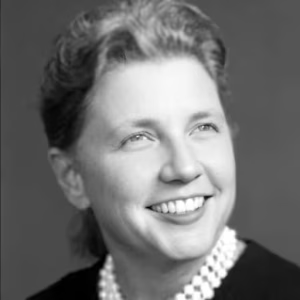
Illustration by Eduard Pech
Leigh Douglass Brackett was born on December 7, 1915, in Los Angeles, California. Her arrival coincided with a world still echoing from the Great War, a dissonance that perhaps seeded within her a lifelong fascination with worlds both familiar and utterly alien. She didn’t emerge from a cloistered academic life; instead, she bloomed amidst the burgeoning pulp magazines of the 1930s–a landscape painted in vivid hues of adventure, danger, and the boundless possibilities of tomorrow.
Brackett wasn’t merely a writer of science fiction and fantasy; she was a force that reshaped its very contours. In an era dominated by male voices, she carved out a space for herself with a distinctive style – one steeped in romantic fatalism, hard-boiled dialogue, and a keen understanding of human nature even when transplanted to the furthest reaches of the galaxy.
Her early work appeared in Astounding Science Fiction and other pulp staples, quickly establishing her as a talent to watch. But it was her move into longer form fiction, particularly her series of stories set on Mars—including the Eric John Stark novels—that truly cemented her reputation. These weren’t tales of gleaming utopias or coldly logical futures. Brackett’s worlds were rough-hewn, populated by flawed heroes and morally ambiguous villains. They felt lived in, scarred by history and driven by primal needs.
Consider the stark beauty of her prose, a quality that echoes through stories like “Last Call From Sector 9G.” The narrative isn’t simply about events unfolding; it’s about the weight of isolation, the desperate search for connection in an uncaring universe, and the lingering ghosts of past choices. This is a hallmark of Brackett’s work: a melancholic undercurrent that elevates her adventure stories beyond simple escapism.
Compared to contemporaries like Robert A. Heinlein, who often focused on social commentary through technological extrapolation, or Isaac Asimov with his intricate puzzle-box narratives, Brackett offered something different. Where they built worlds around ideas, she built them from character. Her influence can be seen in the later work of authors like Ursula K. Le Guin, whose own explorations of alien cultures and complex moral landscapes owe a debt to Brackett’s pioneering spirit. Even Philip K. Dick is said to have acknowledged her impact, recognizing in her writing a similar fascination with the fragility of reality and the shifting boundary between perception and reality.
Brackett wasn’t confined to prose alone. She transitioned successfully into screenwriting, contributing to iconic films like The Big Sleep (with Raymond Chandler) and Rio Bravo. This experience further honed her dialogue skills—a talent that infused her fiction with a gritty realism rarely found in the genre at the time.
Leigh Brackett died on March 24, 1978, leaving behind a legacy as “the Queen of Space Opera.” But to call her simply a genre writer feels inadequate. She was a storyteller who understood the enduring power of myth, the allure of the unknown, and the fundamental human need for meaning in a vast, indifferent cosmos. Her worlds continue to beckon—not just with adventure, but with a profound reflection on what it means to be alive.
Ray Douglas Bradbury was born August 22, 1920, in Waukegan, Illinois—a place he would forever transmute into Green Town, Illinois, a shimmering echo of memory…
Thornton W. Burgess (January 17, 1874 – June 5, 1965) spent much of his life living in and around the state of Massachusetts in the…
Shopping Basket
Manage Cookie Consent
To provide the best experiences, we use technologies like cookies to store and/or access device information. Consenting to these technologies will allow us to process data such as browsing behaviour or unique IDs on this site. Not consenting or withdrawing consent, may adversely affect certain features and functions.
Functional
Always active
The technical storage or access is strictly necessary for the legitimate purpose of enabling the use of a specific service explicitly requested by the subscriber or user, or for the sole purpose of carrying out the transmission of a communication over an electronic communications network.
Preferences
The technical storage or access is necessary for the legitimate purpose of storing preferences that are not requested by the subscriber or user.
Statistics
The technical storage or access that is used exclusively for statistical purposes.The technical storage or access that is used exclusively for anonymous statistical purposes. Without a subpoena, voluntary compliance on the part of your Internet Service Provider, or additional records from a third party, information stored or retrieved for this purpose alone cannot usually be used to identify you.
Marketing
The technical storage or access is required to create user profiles to send advertising, or to track the user on a website or across several websites for similar marketing purposes.